This reference uses the English BERNINA 435 User Guide. Match your model and guide edition; it is not a full stitch/foot chart and does not establish the fit of an optional accessory. See the official BERNINA 435 User Guide.
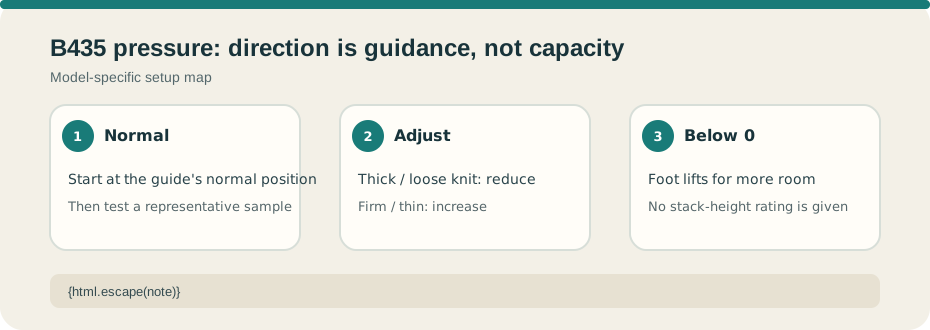
The guide describes a normal pressure setting, then gives relative fabric advice: reduce pressure for tricot or loosely knitted fabric and for thick fabric; increase it for firm or thin fabric. These are separate descriptions in the source. It does not reconcile a material that is both firm and thick, so do not invent a combined rule. If your sample fits both descriptions, consult the exact manual or BERNINA support instead of guessing.
The pressure knob changes presser-foot pressure. Turning it to the right reduces pressure; continuing below 0 lifts the foot to provide more room. That lift is a control position, not a rated stack height or proof that the machine can sew a particular number of layers. The guide does not provide numeric pressure steps or a clearance rating. The guide also lists optional pintuck feet with selected twin-needle pairings. Those pairings are an accessory/task reference, not a complete stitch/plate clearance matrix or proof that a foot came with your machine; verify the exact foot and sewing setup in the manual.
Test the actual fabric, needle, thread, foot, and seam bulk. Begin with the documented normal position, observe feeding and stitch formation, and make only a small manual-directed adjustment. Stop if the foot cannot sit as intended, the needle contacts the plate or foot, the machine strains, or the fabric needs to be forced. See the exact-model manual matching guide before applying settings from another BERNINA series.