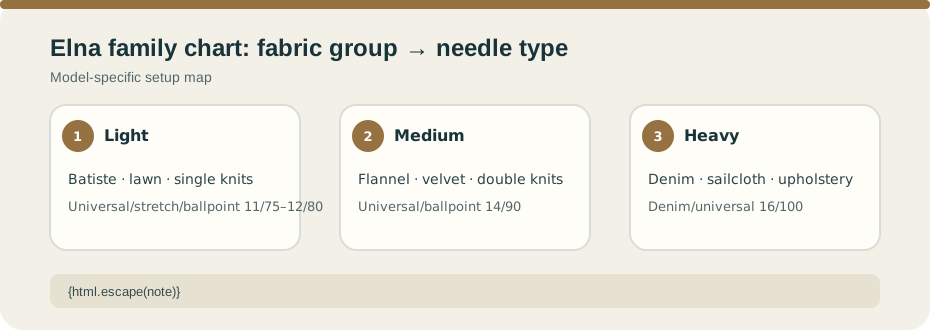
The Elna 3210/3230 English family guide has a shared fabric/needle chart. Confirm your model and use the matching edition; do not treat the 3210 data sheet as operating instructions for both models. The chart groups fabrics qualitatively, and the labels do not set a numeric machine-capacity limit. See the official Elna 3210/3230 Instruction Book (2018).
For very light chiffon, lace, or organdy, the chart lists a universal or ballpoint needle size 9/65. For light batiste, lawn, crepe, and similar fabrics, it lists stretch or universal 11/75 or 12/80; single knits use a stretch or ballpoint 11/75. Light leather is paired with a leather needle 11/75. Medium examples such as flannel and velvet use universal 14/90; double knits use ballpoint 14/90, and leather/vinyl use 14/90.
For heavy denim and sailcloth, the chart lists a denim needle 16/100. Coating, polar fleece, drapery, leather, and suede have their own universal or leather 16/100 entries. The very-heavy row includes canvas, duck, and upholstery with a universal 16/100. Topstitching lists 11/75 or 14/90. These are chart recommendations; the guide does not give a thread-size value, fabric-weight threshold, or per-stitch clearance for these rows.
Choose the closest chart row, then make a sample with the actual layers, thread, foot, and selected stitch. Do not fill missing thread values from another brand or model. Stop if the needle hits the foot or plate, the machine strains, or feeding requires force. Care instructions in this family manual belong to maintenance guidance, not a reason to change stitch settings.