The Toyota SP100 family manual covers several named variants and marks features that apply only to some. Check your exact model code and the manual that came with it before using a chart row. The inspected manual is for a 220–240 V, 50 Hz market; its electrical specifications do not apply to US or Canadian machines, and North American equivalence was not established. See the official Toyota SP100 Series Home-Use Sewing Machine Instruction Manual.
Read the needle and thread together#
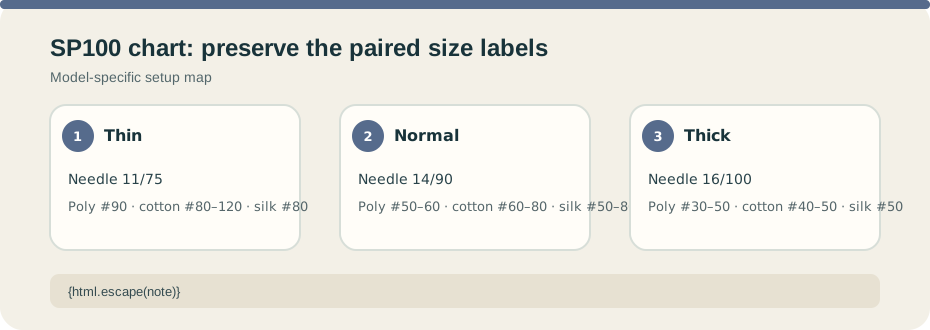
The chart groups material as thin, normal, or thick and pairs each group with needle and thread sizes. In the thin row it lists needle 11/75, polyester thread #90, cotton #80–120, or silk #80. The normal row lists needle 14/90, polyester #50–60, cotton #60–80, or silk #50–80. The thick row lists needle 16/100, polyester #30–50, cotton #40–50, or silk #50. Keep each thread type and number paired as printed; do not convert them into diameter or compare unlike numbering systems.
The manual’s fabric examples are qualitative, not numeric thickness or machine-capacity limits. For stretch fabric it recommends a ballpoint needle. It also directs users to test and recommends matching upper and bobbin thread type. Check your selected stitch, foot, and variant-specific controls separately: this family chart does not provide a complete per-stitch clearance matrix.
Test on the real fabric and layers before the project. If the result is poor, change one factor at a time within the matching manual’s guidance. Stop if the needle contacts the foot or plate. Do not use this manual’s voltage or variant-specific features to identify a machine in another market.