This guide applies to the Janome HD-3000 described by the linked instruction book. Confirm the full model name and use the manual supplied with your machine, especially if its market or revision is different. Janome’s US product listing identifies its HD-3000 as UPC 732212274473 and lists 18 stitches, a four-step buttonhole, manual tension, adjustable foot pressure, and a 4 mm maximum stitch length. These are listing specifications, not settings for every Janome model.
Set controls with the needle raised#
The manual describes a pattern-selector dial, stitch-length control, zigzag-width control, variable needle position, thread-tension control, and presser-foot-pressure dial. It states a 6.5 mm maximum zigzag width and says to raise the needle above the fabric before changing stitch width. Raise the needle before turning the pattern selector as well.
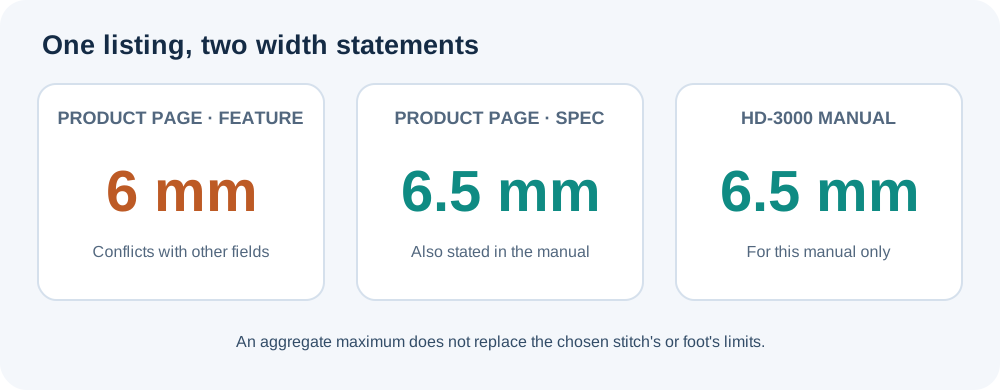
The product page conflicts with itself on maximum width: one feature says 6 mm, while another feature and its detailed specification say 6.5 mm. The linked HD-3000 manual also says 6.5 mm. Keep the discrepancy in view and use the correct manual for your machine; an aggregate maximum does not replace limits for a selected stitch or foot.
Needle and threader limits#
The manual says the built-in needle threader is intended for needle sizes #11–#16 or a blue-tipped needle. It also says thread sizes 50–90 should work well. Check the package and manual rather than treating these ranges as a universal needle-and-thread conversion chart. Choose a needle suited to the fabric and thread, and test the full combination on a scrap.
Level the foot for a thick seam#
For straight stitching on heavy fabric, the manual describes using the black button on the zigzag foot to hold the presser foot level while lowering it. Follow this sequence from the manual:
- Lower the needle into the fabric at the starting point.
- Press the black button on the zigzag foot.
- Lower the presser foot while keeping the button pressed.
- Release the button, then sew the seam.
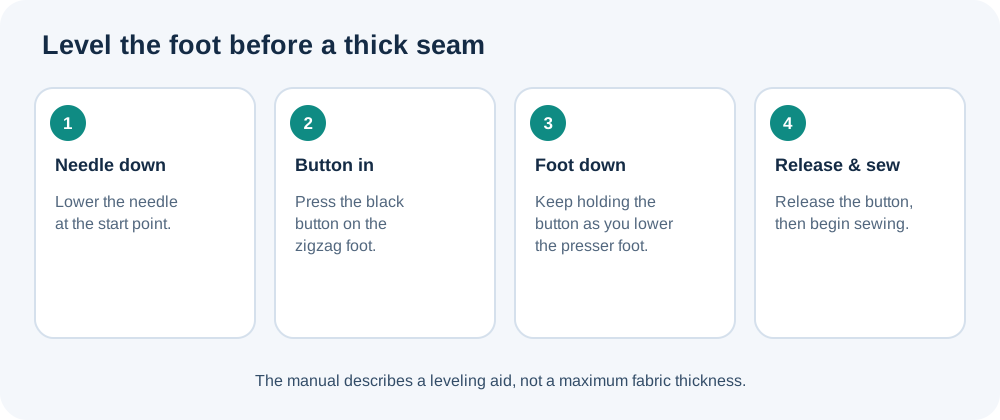
This helps the foot begin level; it is not a thickness rating or evidence that every stack will feed safely. Sew a representative sample and let the machine feed the fabric. Stop if the needle bends, contacts the foot or plate, or the machine strains. For other stitches and controls, use the HD-3000 instruction book and the model identification guide.