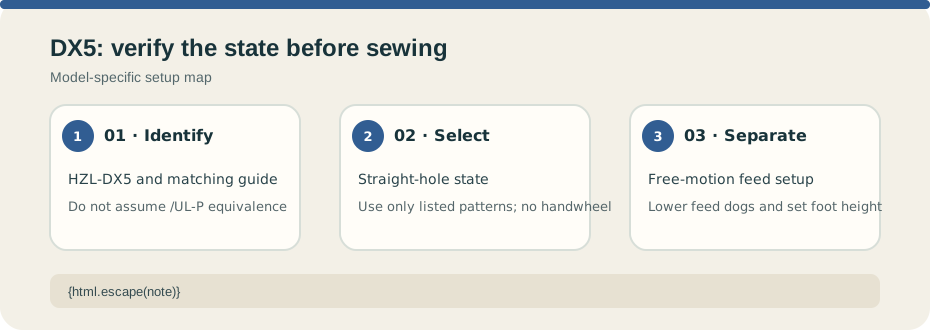
Use this reference for the JUKI HZL-DX5 covered by the US DX-series materials. Match your model and the exact manual URL before changing the plate state; this evidence does not establish equivalence with HZL-DX5/UL-P or every DX-series revision. This page summarizes one documented state. Use the diagrams and permitted-pattern list in the manual supplied with your machine. See the official JUKI HZL-DX5 product and support page.
Treat plate selection and free motion as separate states#
For the straight-stitch plate state, raise the needle and presser foot. Move the slide-plate lever left while pushing it slightly away as the manual shows. The manual limits which patterns may be selected in this state. Check that list before sewing; do not treat the straight-hole plate position as a general needle-clearance setting for every stitch.
The manual warns not to turn the handwheel while the straight-stitch plate state is selected. Return the lever to the normal position before switching the machine off. If the machine’s state or needle position is uncertain, stop and consult the exact diagram rather than forcing the lever or turning the handwheel.
Free-motion sewing is a different setup: the manual describes lowering the feed dogs and setting the foot height for that technique. Those controls do not replace the plate’s pattern restrictions, and the two feature descriptions do not prove every combination is allowed. Check the selected foot, needle, and stitch in the matching manual, then test the real quilt layers at low speed. A fabric example on a product page is not a capacity guarantee. See the category’s model/manual matching guide; general quilting technique belongs in the task guides.