This guide summarizes selected details from SINGER’s US 9960 product listing and an English-language 9960 manual hosted by SINGER Turkey. The manual is dated 2010 and does not identify an individual machine’s market or production revision. Check the model label and supplied manual before using a chart or accessory instruction.
The US product page distinguishes 600 built-in stitches from 1,172 stitch applications. It also lists push-button stitch selection with a preview of style, width, and length; needle up/down; variable speed control; and a thread-trimmer button. Stitch applications describe techniques possible with selected stitches, so they are not an additional built-in stitch count. The product page is a feature list rather than a complete operating chart.
Use the fabric chart as a selection guide#
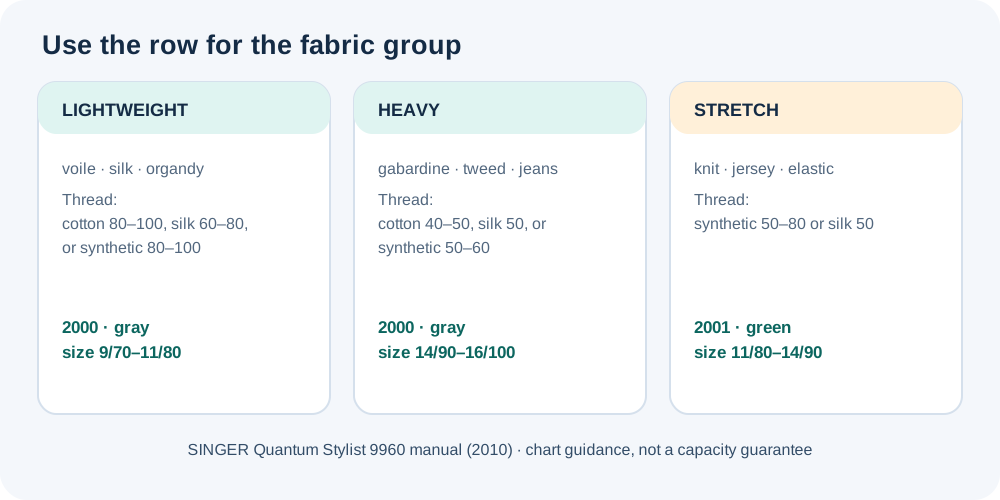
The 9960 manual groups fabric, thread, and needle examples by weight and stretch. Its heavy-fabric row includes gabardine, tweed, jeans, and corduroy, with cotton thread 40–50, silk 50, or synthetic thread 50–60 and Singer needle system 2000, gray, size 14/90–16/100. For lightweight fabrics such as voile, silk, and organdy, its chart gives size 9/70–11/80 and different thread ranges. Stretch fabrics have a separate entry using Singer system 2001, green, size 11/80–14/90. Choose from the exact chart row that fits your fabric and thread, then test the combination; the table does not set a maximum thickness.
Twin-needle mode is a required check#
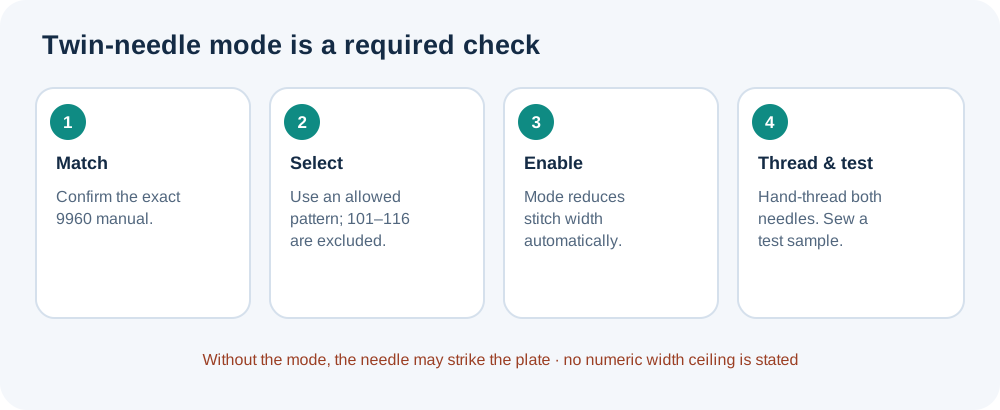
The manual permits twin-needle sewing with all patterns except 101–116 and specifies Singer Style 2025. Select the machine’s twin-needle mode before sewing: the mode reduces stitch width automatically. The manual warns that without this mode the needle can strike the needle plate. It gives no numeric reduced-width limit, so do not infer one or substitute a generic clearance value. The needle threader cannot be used with a twin needle; thread each needle by hand as the manual directs, and sew a test sample.
The manual also says pattern 2 is a left-needle straight stitch and is most suited to lightweight fabrics. That instruction is specific to this 9960 pattern. Check the selected stitch, needle, foot, and machine clearance in the 9960 manual rather than transferring a setting to another computerized machine.