A fabric weight number describes a measurement basis, not how thick or easy to sew the fabric will feel. Before comparing a listing with another fabric, find out whether it reports mass per area or mass per length, the units, the stated width, and how the specimen was measured. An “ounce” figure without its basis is not enough to compare products.
Keep the measurements separate#
Mass per area (often shown as grams per square metre, or GSM) divides sample mass by area. Mass per length divides mass by a length of fabric and depends on its width. ISO 3801 explicitly covers woven-fabric mass per unit length and mass per area as separate quantities; its scope should not be silently generalized to every knit or nonwoven.
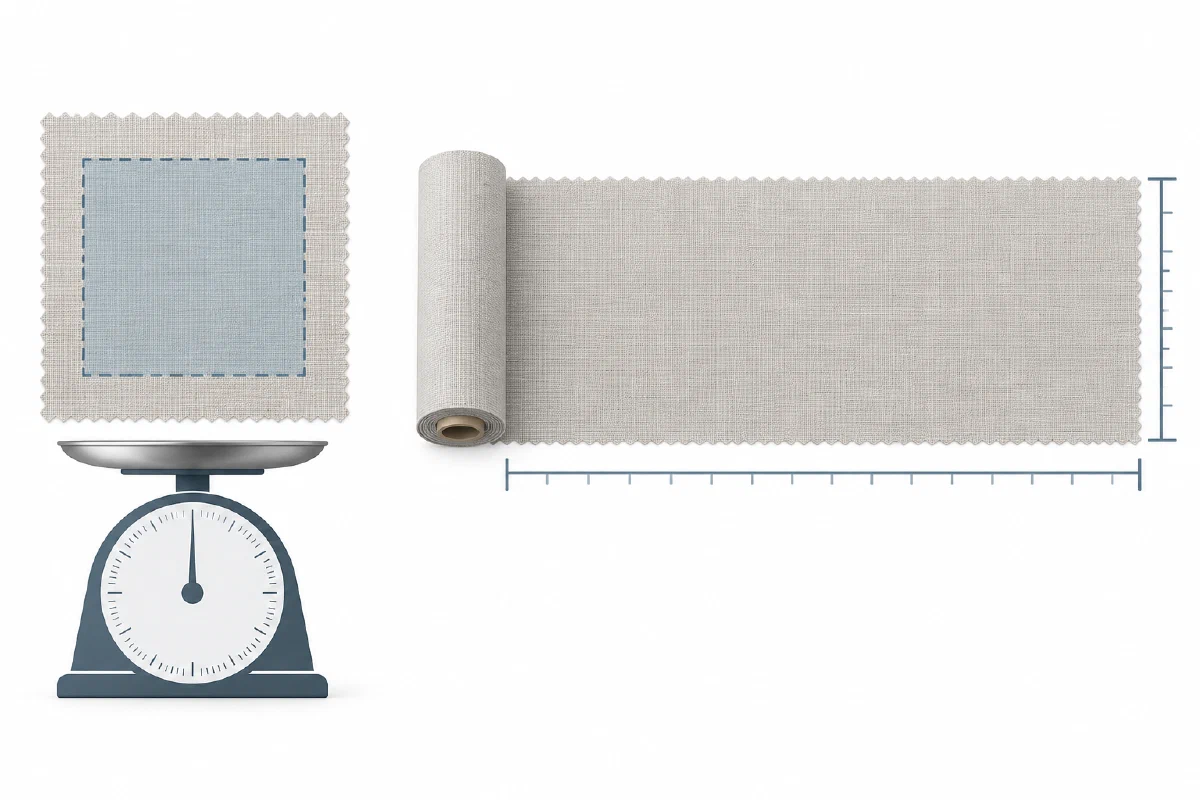
Mass per area and mass per length use different sample bases; the drawing is not a test method.
Thickness is a different dimension. A lofty fleece, a compact coating, and a soft woven can have similar mass per area while compressing and bending differently. Thickness readings can also depend on the measurement method and pressure. Ask what pressure or method produced the figure, especially if the material is compressible. Do not turn GSM, ounces, or a retailer’s “lightweight” label into millimetres, a needle recommendation, or a safe layer count.
Fabric hand is also multidimensional. Bending resistance affects how readily cloth folds; shear and stretch affect how it moves; compression and recovery affect loft; surface friction changes drag. Textile researchers measure these as distinct properties, but instrument values are not home-sewing thresholds. A study of controlled single-jersey fabrics also found thermal resistance related to several structure measures together; it does not give a warmth conversion for an individual fabric.
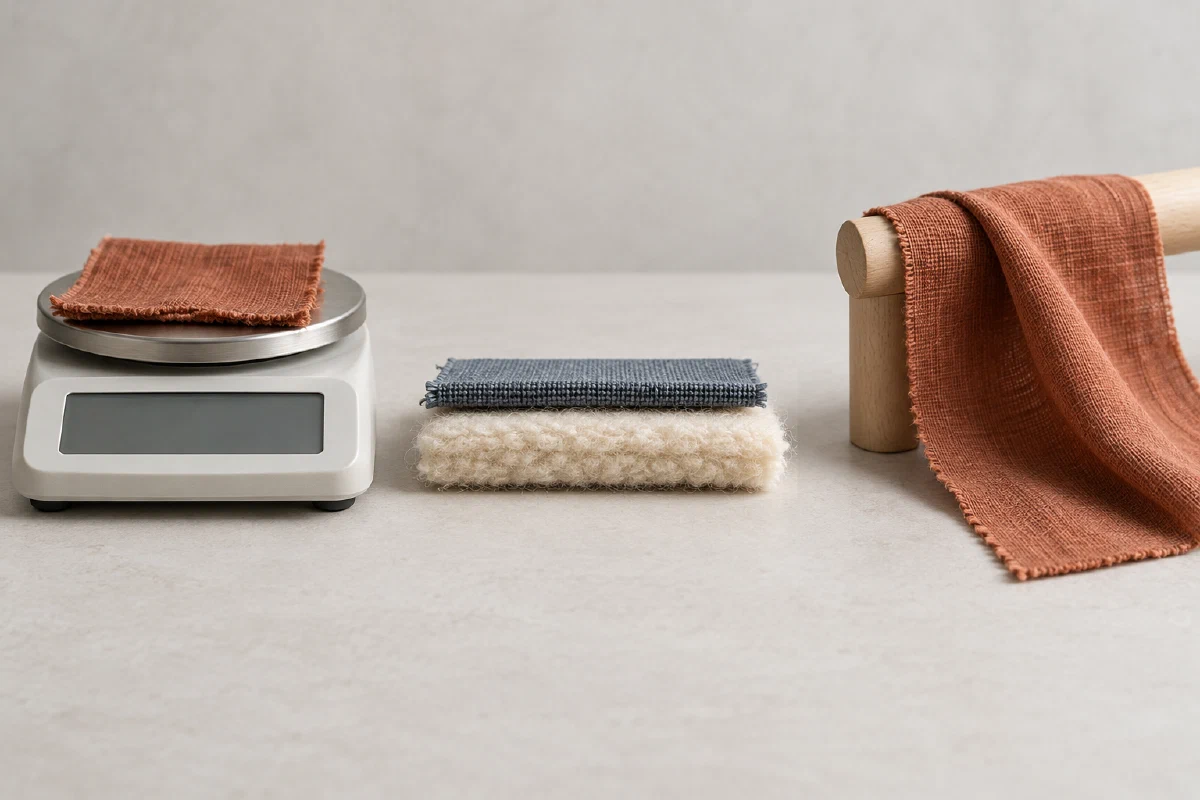
Mass, thickness, and drape are different observations; the illustration is conceptual, not a measurement procedure.
Ask for the missing information, then sample#
For a useful specification, record the exact product, fibre blend, construction, width, mass basis and units, thickness method if available, finish or coating, stretch and recovery, and care instructions. If those details are unavailable, describe what you can observe: number of layers, loft, compressibility, drape, and surface drag. Then sew an offcut with the complete project stack and seam intersection using a setup permitted by your machine manual.
Use a weight figure as one part of a material profile, not a sewing verdict. For garment support, compare the separate interfacing guide; for a dense folded transition, profile the actual denim seam stack.