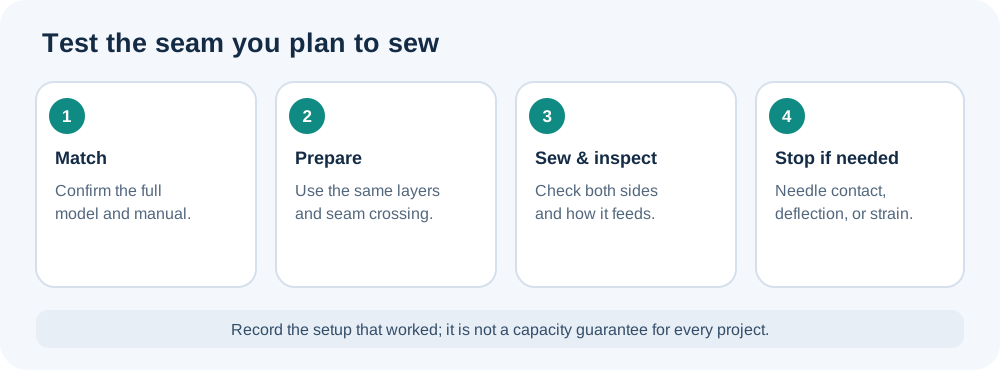
SINGER’s FAQ gives starting advice for denim and other heavy fabrics, but it is general SINGER guidance rather than a 4423-only stitch chart. Use it alongside the manual for your exact SINGER 4423 and treat every number as something to test on the actual fabric stack.
Identify the listing before applying its details#
SINGER Canada’s “4423 Meltwater Blue” listing identifies SKU 230489112. That is the identity of this Canadian storefront listing, not a serial-number or manual-revision lookup for every 4423. Bundle contents and details can vary by listing, market, and production version, so check the machine label and its supplied manual.
SINGER’s current 4423 product page points readers to the Heavy Duty 4523 as a newer model and describes speed control as an added feature. The 4523 has a dedicated manual with its own needle guide, control ranges, and setup examples. See the SINGER 4523 settings guide; do not transfer its settings, accessories, or manual instructions to a 4423.
Denim starting point#
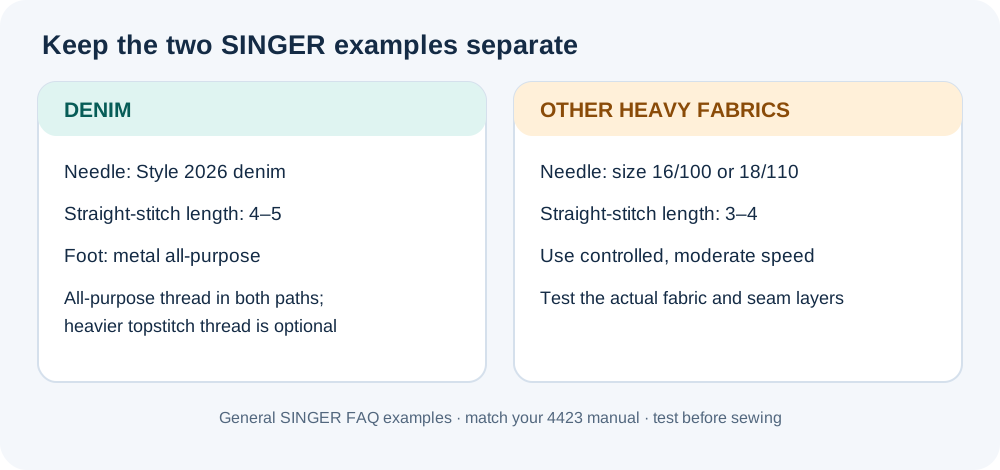
For denim, SINGER recommends its Style 2026 denim needle, size 16/100, a straight-stitch length of 4–5, an all-purpose metal foot, and all-purpose thread in both the upper path and bobbin. The FAQ describes the length as a starting value; the fabric weight, seam bulk, and stitch appearance still determine whether it works on your sample.
If you are topstitching denim with heavier topstitch thread, SINGER gives a separate option: put that thread in the upper tension path only and use regular all-purpose thread in the bobbin. This is the FAQ’s general SINGER guidance, not a 4423-specific requirement. Test the combination on the same layers you plan to sew and confirm that the needle and stitch remain suitable.
The SINGER needle guide also identifies Style 2026 for denim and canvas. Match the needle package and machine manual rather than relying on a size number alone. A bent, dull, or incorrect needle can cause skipped stitches or damage.
Other heavy fabrics are a separate case#
For heavy material other than denim, SINGER’s FAQ suggests a size 16/100 or 18/110 SINGER needle and a stitch length of 3–4, with controlled moderate speed. Those values should not be blended into one universal denim recipe. Select a needle appropriate to the material and thread, then test a sample with the same layers and seam junctions as the project.
The 4423 product information lists an adjustable presser-foot pressure control. That tells you the model has a control, not which pressure number to use for a particular textile. The FAQ does not provide a 4423-specific pressure value. Consult the machine manual before changing pressure, and return to its recommended position if the feed becomes uneven.
Test before sewing the project#
Use the standard foot only if it is the correct foot for the stitch and your manual. Sew a scrap seam, inspect both sides, and check that the machine feeds without being pushed or pulled. If the needle bends, hits the plate or foot, or the machine strains at an intersection, stop and reassess the material stack and manual limits. Do not force a bulky seam through just because the 4423 is marketed as a heavy-duty model.
Record the fabric, layers, needle, thread, foot, stitch, and settings that passed your test. That is a useful repeatable setup for the same materials, not a capacity guarantee for every denim or heavy fabric.