The shared English manual names the SINGER HD 6600C and HD 6605C. Check your machine label and supplied manual before using these instructions. The manual does not establish that the two models are equivalent to other SINGER Heavy Duty machines such as the 6800C, 4523, or 4423.
Select a stitch and set its controls#
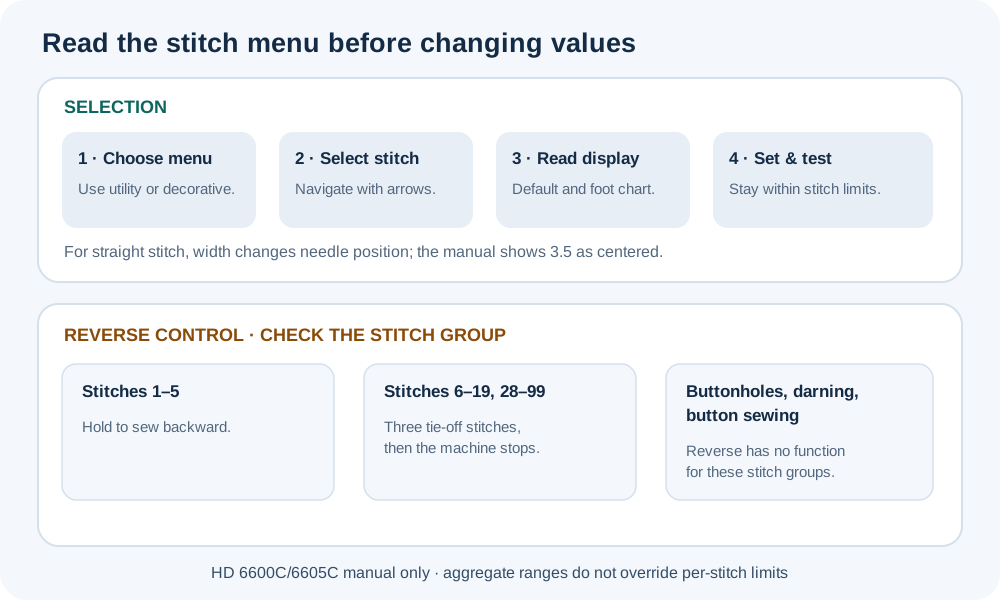
The computerized panel separates utility/decorative stitch selection from width and length adjustment. Use the navigation arrows to choose a stitch; the display shows its defaults, and the sliding chart identifies the recommended foot. The manual gives overall width and length ranges of 0–7 mm and 0–4.5 mm, but individual stitches can allow less. For a straight stitch, the width control moves the needle position; the manual shows displayed value 3.5 as centered.
Reverse behavior also depends on the selected stitch. For stitch numbers 1–5, hold the reverse button to sew backward. For stitches 6–19 and 28–99, it makes three tie-off stitches and stops. The button has no function for buttonholes, darning, or button-sewing stitches. Confirm the selected stitch group in the manual before relying on the button.
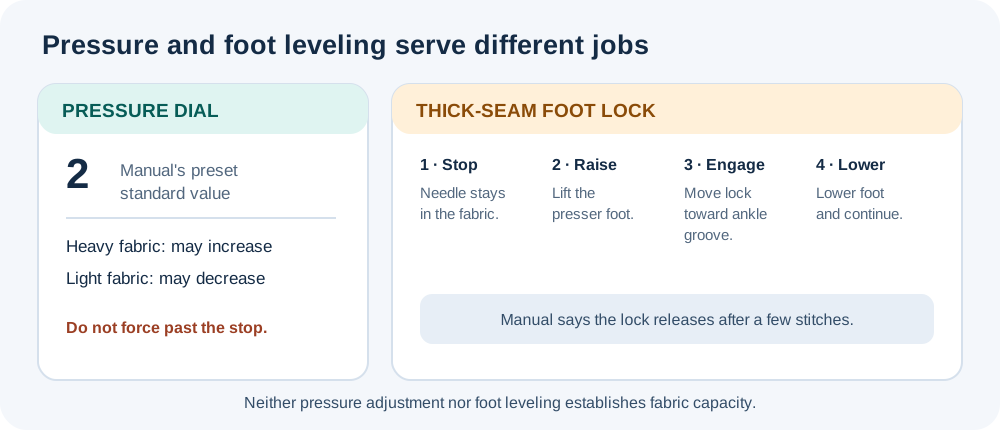
The presser-foot-pressure control is preset to 2. The manual says to increase it for heavy fabric and decrease it for lightweight fabric, without turning the dial past its stop. It recommends system 130/705H needles; its chart includes size 100/16 for heavy fabrics such as canvas, denim, fleece, and heavy knit. It warns against asymmetrical twin needles.
Use the foot lock at a thick seam#
For a jeans hem or extra-heavy seam, the manual explains how to hold the all-purpose foot level as it crosses the thicker section: stop with the needle in the fabric, raise the foot, engage the foot’s lock button toward the groove in its ankle, then lower the foot and continue. The lock releases after a few stitches. This procedure does not give a maximum thickness or make forced feeding safe. Test the full seam on a sample and stop if the needle bends, contacts the foot or plate, or the machine strains.