The shared English manual names both the SINGER HD 6800C and HD 6805C. Its procedures apply to those named models as described by that manual; it does not establish that every market or production revision is identical. Confirm the label on your machine and the manual supplied with it. Do not transfer these settings to the mechanical 4423 or another computerized Heavy Duty model.
Read the display and stay within each stitch’s range#
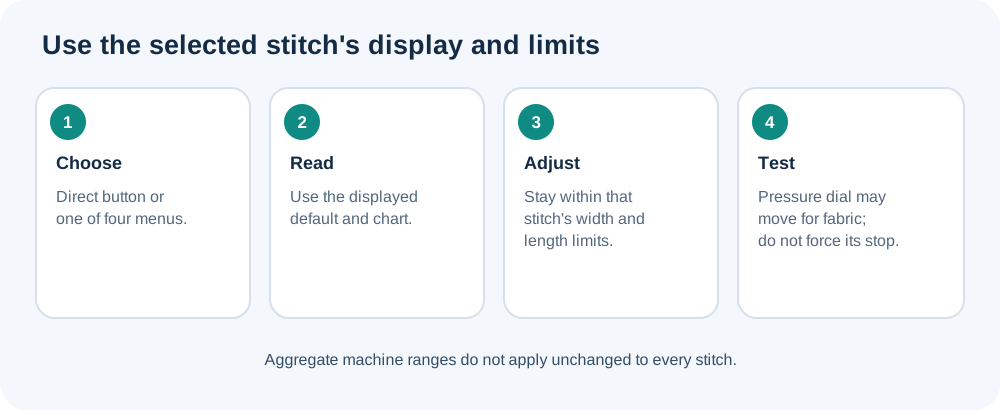
The manual describes direct stitch selection, four menus, displayed stitch defaults, sequence programming, mirroring, elongation, speed control, needle up/down, tie-off, and automatic thread cutting. Its aggregate width range is 0–7 mm and its length range is 0–4.5 mm, but it notes that individual stitches can have narrower limits. Use the displayed defaults and the manual’s stitch information rather than treating the aggregate maximum as a setting for every stitch.
The pressure dial is preset to standard value 2. The manual says it may be increased for heavy fabrics or decreased for lightweight fabrics; do not force the dial past its stop. Its needle chart recommends system 130/705H and includes size 100/16 for denim and other heavy fabrics and size 110/18 for coat-weight wool and upholstery. The manual warns against asymmetrical twin needles.
Reverse behavior depends on the stitch group#
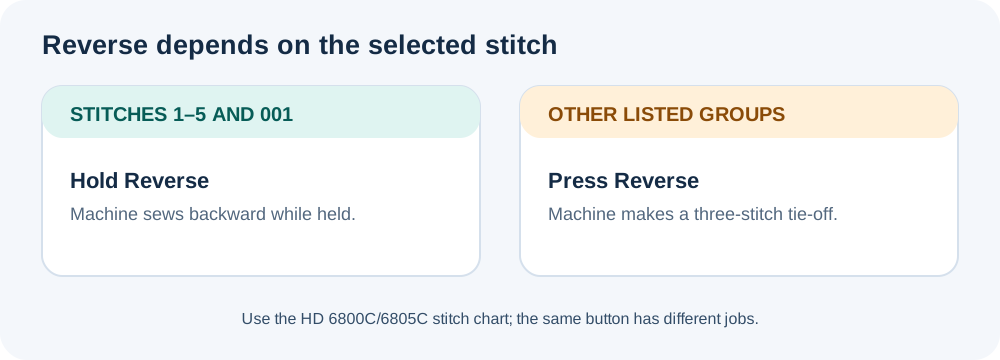
For stitch numbers 1–5 and 001, the manual says the machine sews in reverse while the reverse control is held. For other listed stitch groups, the control makes a three-stitch tie-off instead. Use the stitch chart for the selected pattern; the reverse button is not one universal operation across the machine.
SINGER’s US 6800C product listing identifies SKU 230256112, but its application count conflicts internally: highlights/specifications say 586 while the FAQ says 548. The listing also advertises up to 1,100 stitches per minute, while the manual specifies a maximum 1,000 ± 50 rpm under a straight-stitch/default-length condition. These claims have different wording and context and are not reconciled here. Use the manual for setup, sew a test sample, and do not treat marketing language as a fabric-thickness rating.