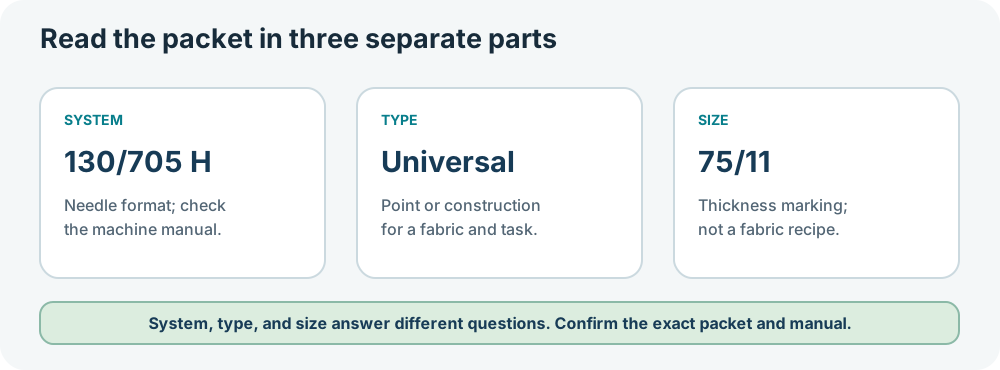
Needle packets often show several codes at once. They answer different questions: the system describes the needle format, the type describes its point or construction, and the size describes its thickness. A matching number alone does not show that the needle suits your fabric, thread, or machine.
What 130/705 H means#
130/705 H is a common household sewing-machine needle system. In SCHMETZ terminology, 130/705 H identifies a flat shank and a scarf, the indentation above the eye. The H is not a fabric recommendation or needle size. Some older, specialty, serger, embroidery, and industrial machines use other systems, so check the manual before buying a replacement.
How 75/11 and 90/14 relate#
Many household packets pair a metric size with a Singer-style or American size. Common examples are 75/11 and 90/14: the smaller number is the finer needle. SCHMETZ defines metric size from blade diameter in hundredths of a millimeter, so a metric 75 needle has a blade diameter of 0.75 mm. The paired number is a sizing convention, not a guarantee about the best needle for a project.
Type and size remain separate choices. For example, a 90/14 may be offered in several needle types. Choose the type for the fabric and task, then choose a size that carries the thread and suits the fabric layers, within the machine maker’s limits. See the fabric-first needle selector and thread-matching guide.
Product names can overlap with system codes#
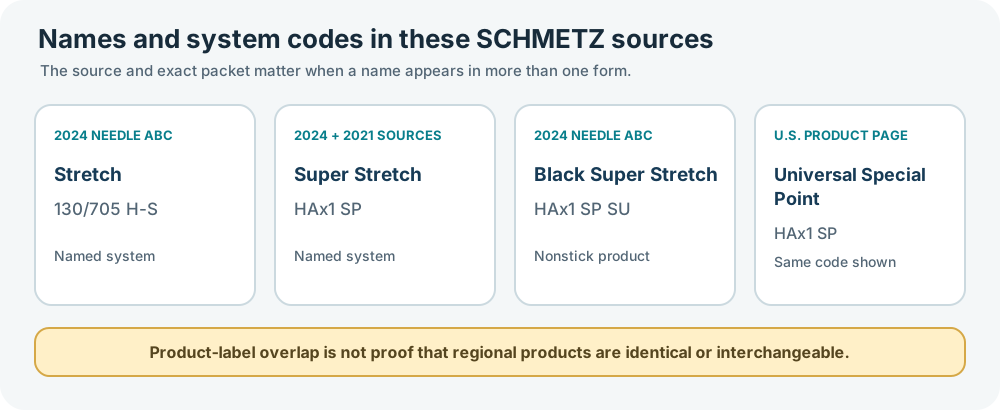
SCHMETZ’s U.S. product page calls HAx1 SP “Universal Special Point,” while its 2024 Needle ABC uses “Super Stretch” for HAx1 SP. That catalog separately identifies Stretch as 130/705 H-S and Black Super Stretch as HAx1 SP SU. These are maker-specific product labels; the shared HAx1 SP code does not prove two regional products are identical or interchangeable. Check the exact packet and your machine manual. See the U.S. product page, the 2024 Needle ABC, and the 2021 data sheet.
Read color bands cautiously#
Color marking is manufacturer-specific. SCHMETZ uses an upper band for type and a lower band for size on many of its needles; its Universal needles use one size band. Other makers and product families may use different markings or none at all. Read the packet and manual instead of treating color as a cross-brand code.
Before sewing, confirm the system and insertion direction in the manual. Replace a bent or damaged needle, insert it fully as directed, and test the selected type, size, thread, fabric, and stitch on a scrap. If the needle hits the plate or foot, stop and verify the model’s clearance and stitch limits.