Thread choice involves more than the number printed on a spool. Fiber, construction, thickness, surface finish, and elasticity affect how thread feeds, passes through the needle, and forms stitches. Spun, corespun, and filament threads can behave differently even when their labels look similar. Coats’ specialist guide identifies even diameter, a smooth surface, abrasion resistance, and elasticity among the factors that affect thread sewability.
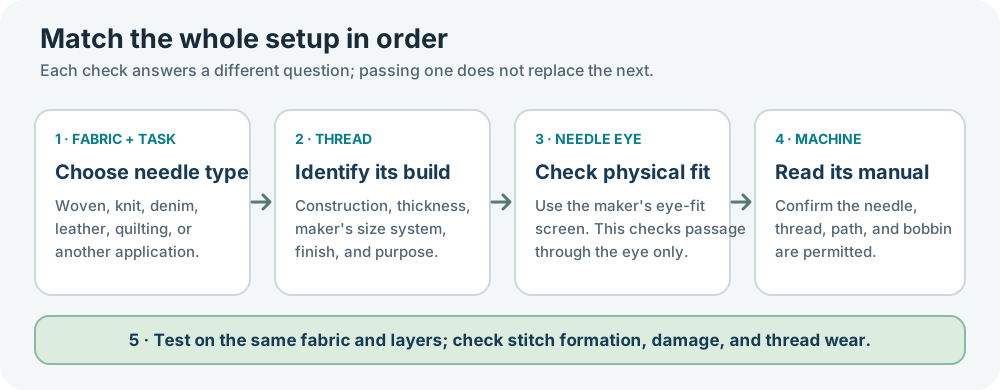
Choose in this order#
- Identify the fabric and task. Pick a needle type for woven, knit, stretch, denim, leather, quilting, or decorative work. The needle-type selector explains common starting points.
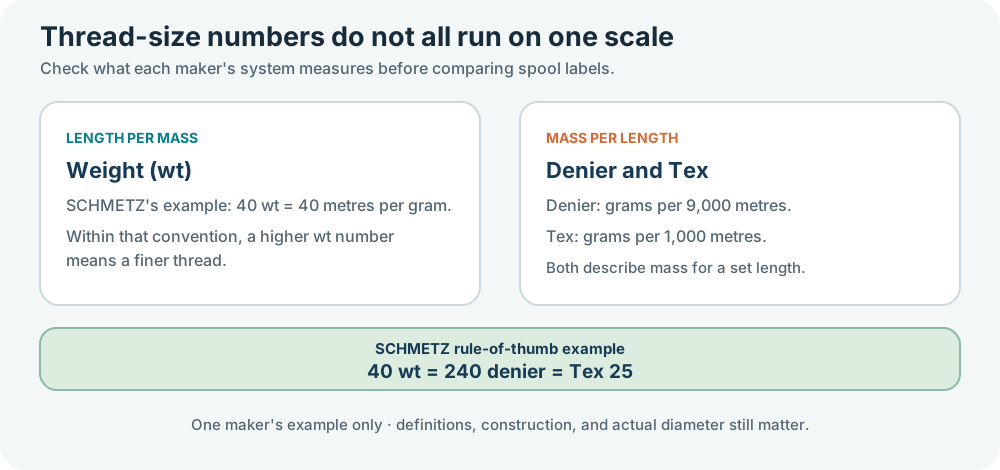
- Check the thread maker’s size system. Weight, ticket, Tex, denier, and metric count do not form one universal conversion table. Some systems count length per mass and others mass per length; construction and manufacturer definitions matter. Use the thread maker’s diameter information when available.
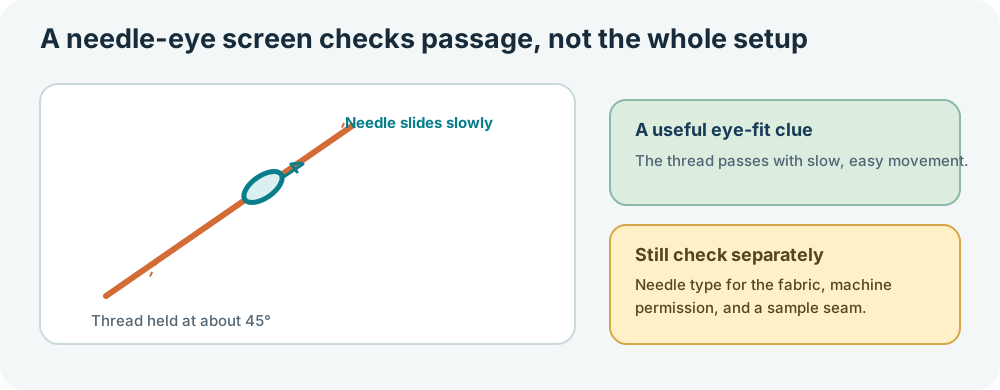
- Match the needle eye to the actual thread. SCHMETZ describes a practical screen: hold the thread at about a 45-degree angle and see whether a suitably matched needle slides slowly down it. This checks eye passage only. It does not prove that the needle type suits the material or that the machine accepts the combination.
- Read the machine’s limits. A manual or model support table may set permitted needle sizes, thread ranges, bobbin pairings, or special-thread restrictions. For a model-specific example, the Brother CS7000X guide keeps its fabric table and automatic-threader limits in their documented scope.
- Sew a test sample. Use the project fabric and layer count. Check stitch formation, skipped stitches, thread fraying, fabric holes, and puckering. Adjust one variable at a time and record a successful setup.
Why the labels do not make a recipe#
Finer thread often needs a finer needle, while a thread that is too thick for the eye can rub, shred, or break. A needle that is too large can leave visible holes or disturb delicate fabric; one that is too small may not carry the thread cleanly. These are relationships, not a table that converts every thread weight into one needle size.
A named needle’s eye can differ at the same size#
SCHMETZ’s HAx1 SP sources describe a wider eye and groove than a regular Universal needle; the U.S. product page calls the eye shorter and wider, while the 2021 data sheet connects the geometry to thicker thread in that product’s use. The U.S. page calls HAx1 SP “Universal Special Point,” while the 2024 Needle ABC and 2021 data sheet use “Super Stretch.” This bounded maker example shows why blade size alone does not establish thread fit. Do not infer a universal thread-size ceiling or that regional products with overlapping names are identical; check the exact packet, thread, and machine instructions. See the U.S. product page, 2024 Needle ABC, and 2021 data sheet.
Source tables are bounded examples. ORGAN’s reference table separates cotton, spun polyester, filament, Tex, dTex, Nm, and ticket columns. SCHMETZ’s sizing guide gives one rule-of-thumb example: 40 wt = 240 denier = Tex 25. That is not a complete conversion across brands or constructions. A cited Brother manual family lists a 30–90 weight range and warns against 20 weight or lower. Do not merge those values into a cross-brand chart. The Janome 2212 manual, for example, tells users to match needle and thread to fabric weight and to use the same thread top and in the bobbin; that is guidance for that model, not a rule for every machine. See the Janome 2212 needle, thread, and tension guide for its model-specific examples and stitch-balance cues.
Fine-thread recommendations are product-specific too. WonderFil suggests 70/10 or 80/12 needles for its 80–100wt thread, while Aurifil’s reference card lists other needle examples for its cotton thread weights and applications. Use those as the named maker’s starting points, then check the thread diameter, fabric, and machine manual.
Thread type changes the setup#
SINGER says household machines are designed for regular all-purpose sewing thread and identifies cotton thread as an option for quilting. Topstitch thread may be thicker than general-purpose thread, so check that it passes through the needle eye and that the machine manual permits the combination. Metallic, monofilament or transparent nylon, textured, and elastic threads can have different feeding and needle-threader requirements. Brother, for example, excludes metallic and transparent nylon from the CS7000X automatic threader; that feature limit does not establish whether the machine can sew those threads when manually threaded. Check the exact thread maker and machine instructions for thread path, bobbin use, and needle choice.
Specialty thread can add limits. Metallic, transparent nylon, topstitch, embroidery, elastic, and bonded threads may need a particular needle eye, thread path, bobbin pairing, or manual procedure. A machine’s automatic needle threader may have narrower limits than the machine’s ability to sew a thread when threaded by hand. For heavy bonded thread, see bonded thread on a home machine. For loops or uneven stitches, follow the thread-path-first tension checks.
Elastic thread may use different positions#
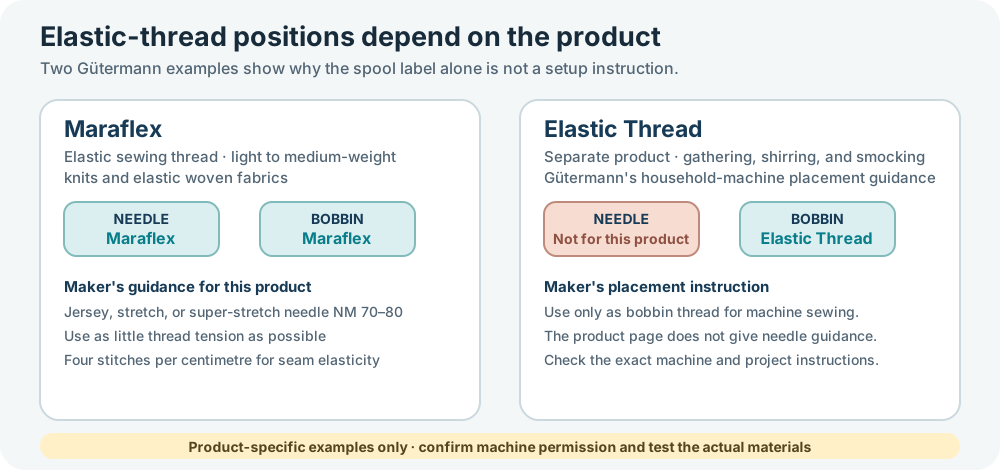
“Elastic thread” does not identify one setup. Gütermann’s Maraflex guidance describes a stretch sewing thread for light to medium-weight knitwear and elastic woven fabrics, used as both needle and bobbin thread. For that product, the maker lists jersey, stretch, or super-stretch needles in NM 70–80, recommends using as little thread tension as possible, and gives four stitches per centimetre as its seam-elasticity guidance. Its separate Elastic Thread product is for gathering, shirring, and smocking and is specified for bobbin use only. These are product-specific instructions, not a universal elastic-thread recipe or proof that a particular machine accepts the combination. Check the thread and machine instructions, then test the exact materials; the controlled tension test-swatch guide covers a measured sample check.