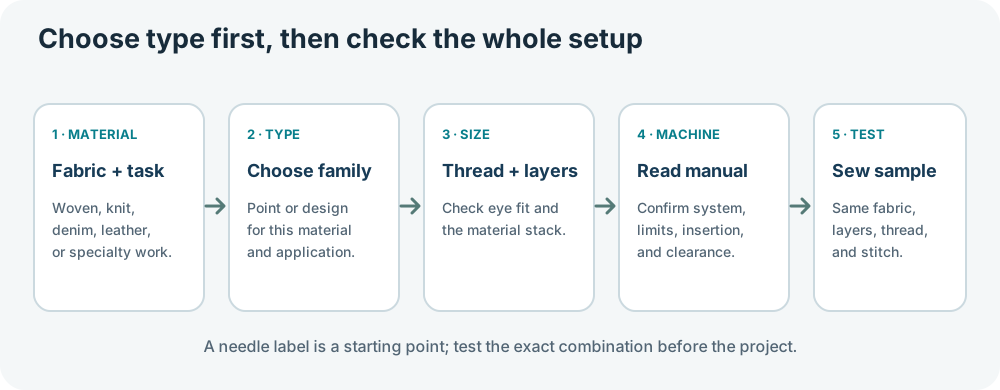
Choose a needle type for the fabric construction and sewing task; choose its size for the thread and material thickness. A needle label is a starting point. The exact machine manual, actual fabric layers, and test seam determine whether the combination works.
| Fabric or task | Common starting type | What to check |
|---|---|---|
| Woven fabric and general sewing | Universal or regular point | A slightly rounded point suits many applications, but very fine, coated, or dense fabric may need another type. |
| Jersey and many knits | Jersey or ballpoint | The rounded point is designed to pass between knit loops. Brand labels are not exact universal synonyms. |
| Highly elastic knit | Stretch | Some stretch needles use a special eye and scarf as well as a suitable point. A fabric name such as Lycra alone does not determine one size for every machine. |
| Denim, jeans, canvas, or duck | Jeans or denim | The reinforced blade is intended for dense woven material. Select size for the thread and layers, and check the manual’s limits. |
| Microfiber, silk, or some coated material | Microtex | Its acute point can help with these applications; test first because a sharp point may mark delicate fabric. |
| Leather or vinyl | Leather | Its cutting point is intended for leather-like material. Do not use it on ordinary woven or knit fabric. |
| Quilting or heavier decorative thread | Quilting or Topstitch | A tapered point or enlarged eye addresses a particular task; neither label replaces a thread-fit check. |
If threading itself is difficult, see the side-slot self-threading needle guide. For free-motion work, a spring needle is a different specialty option with its own machine-specific checks.
Names and recommendations vary among SCHMETZ, SINGER, Janome, and other manufacturers. For example, SINGER identifies its Ball Point 2045 for knits, while SCHMETZ distinguishes Jersey and Stretch designs. Do not infer that two brands’ names, colors, or model ranges are identical. The needle-size guide explains packet markings.
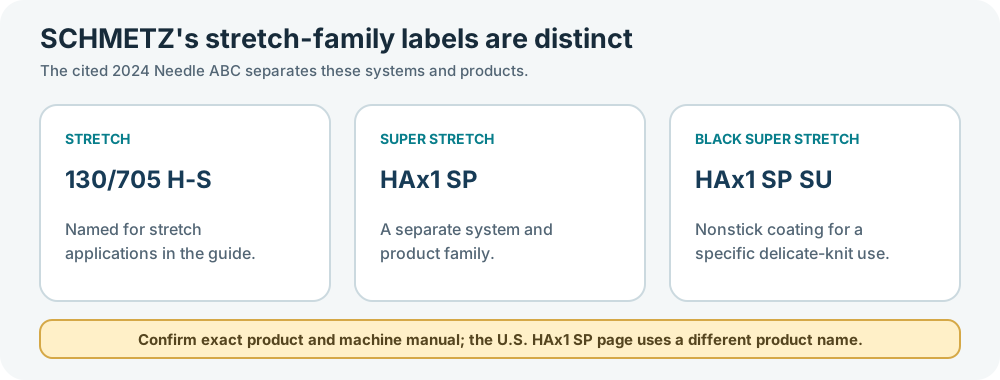
SCHMETZ’s 2024 guide distinguishes Stretch (130/705 H-S), Super Stretch (HAx1 SP), and Black Super Stretch (HAx1 SP SU). It describes separate designs for highly elastic knits; the Black Super Stretch version adds a nonstick coating for delicate, highly elastic stretch fabrics. SCHMETZ’s U.S. page calls its HAx1 SP product “Universal Special Point.” Treat these as source-specific names and features, not proof that regional products are identical or that a needle fits every machine. Check the exact packet and manual. See the 2024 Needle ABC and U.S. HAx1 SP product page.
Test the complete combination#
Check the needle system and any machine-specific type restriction first. Match the needle eye to the thread so the thread passes freely, then sew a sample using the actual fabric, layers, thread, foot, and stitch. Look for skipped stitches, thread shredding, enlarged holes, puckering, or visible fabric damage. Groz-Beckert and AMANN both describe choosing a needle small enough to limit material damage while still carrying the thread. Treat that as a test principle, not permission to exceed a home machine’s limits.
Change one variable at a time. If the thread cannot pass through the eye, choose a compatible thread or needle size. If a needle bends, strikes the foot or plate, or the machine makes a new clicking sound, stop and inspect the setup. See when to replace a needle and how to match thread and needle.