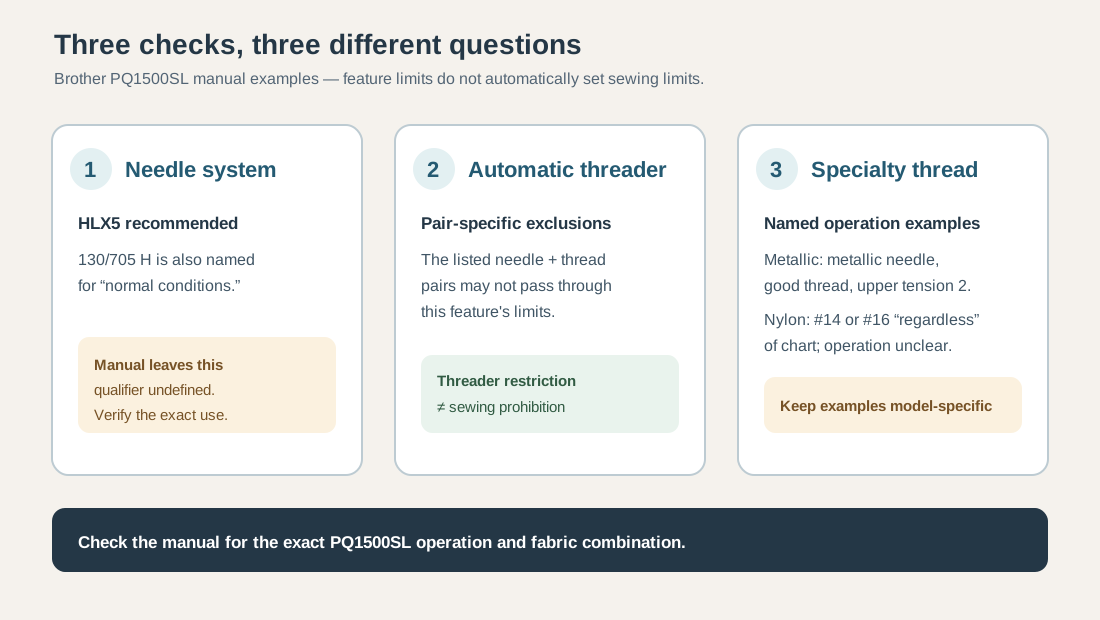
The Brother PQ1500SL manual recommends HLX5 needles. It also permits SCHMETZ 130/705H needles under “normal sewing conditions,” a phrase the manual does not define. Verify the exact model and manual before using that alternate system.
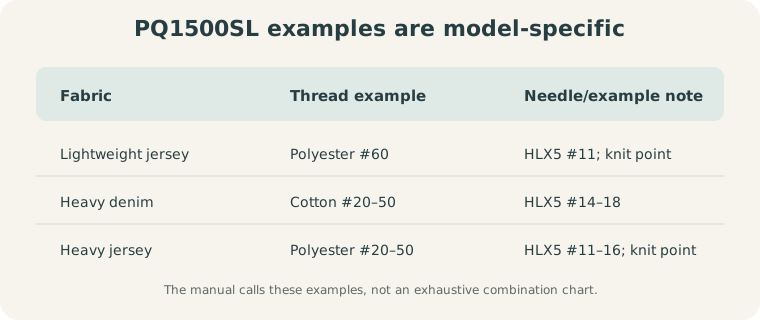
| PQ1500SL manual example | Thread | Needle example |
|---|---|---|
| Lightweight jersey | Polyester #60 | HLX5 #11; use a ballpoint or knit-fabric needle for jersey/tricot |
| Heavy denim | Cotton #20–50 | HLX5 #14–18 |
| Heavy jersey | Polyester #20–50 | HLX5 #11–16; use a ballpoint or knit-fabric needle |
The automatic threader has narrower limits#
Brother lists these pairs as not usable with the built-in threader: HLX5 #9 with thread #20, #30, #50, or #60; #11 with #20 or #30; #14 with #20 or #30; and #16 with #20. That table concerns the feature, not whether a manually threaded combination can sew.
The manual separately says transparent nylon can be used with needle #14 or #16 “regardless of” the chart, but does not restate whether that exception concerns the automatic threader or sewing. Keep the wording narrow and check Brother for the intended operation. For metallic thread, the manual specifies a metallic needle, good-quality thread, and upper tension 2; that is a PQ1500SL example, not a portable setting. It also says to use the included spool net for transparent nylon, metallic, or other strong thread. Follow the manual’s three-hole thread-guide route for polyester or tangling/breaking thread, then its alternate route if the problem continues.
For general eye-fit checks, see the thread-matching guide. For persistent breakage, use Brother’s current exact-model support rather than extending this selection chart.