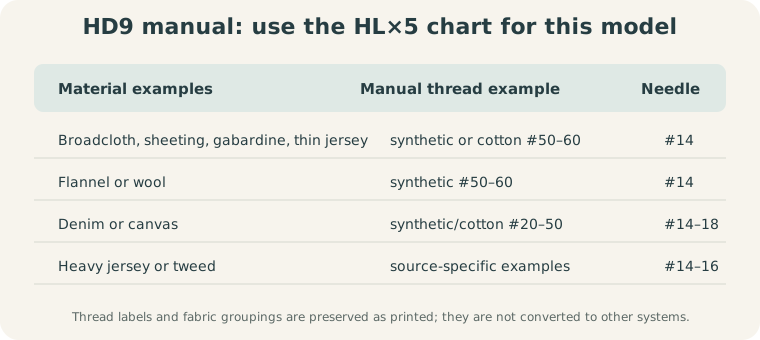
The Janome HD9 manual specifies the HL×5 needle system, inserted fully with its flat side to the right. Its thread and needle chart gives starting examples for this machine; it is not a cross-brand thread-number conversion.
| HD9 manual material example | Thread example | HL×5 needle |
|---|---|---|
| Broadcloth, sheeting, gabardine, thin jersey | Synthetic or cotton #50–60 | #14 |
| Flannel or wool | Synthetic #50–60 | #14 |
| Denim | Synthetic or cotton #20–50 | #14–18 |
| Heavy jersey | Synthetic #20–50 | #14–16 |
| Tweed | Synthetic #20–50 or cotton #30–50 | #14–16 |
| Canvas | Synthetic #20–50 | #14–18 |
| Artificial leather | Synthetic #20–30 | #14–18 |
Keep feature limits separate#
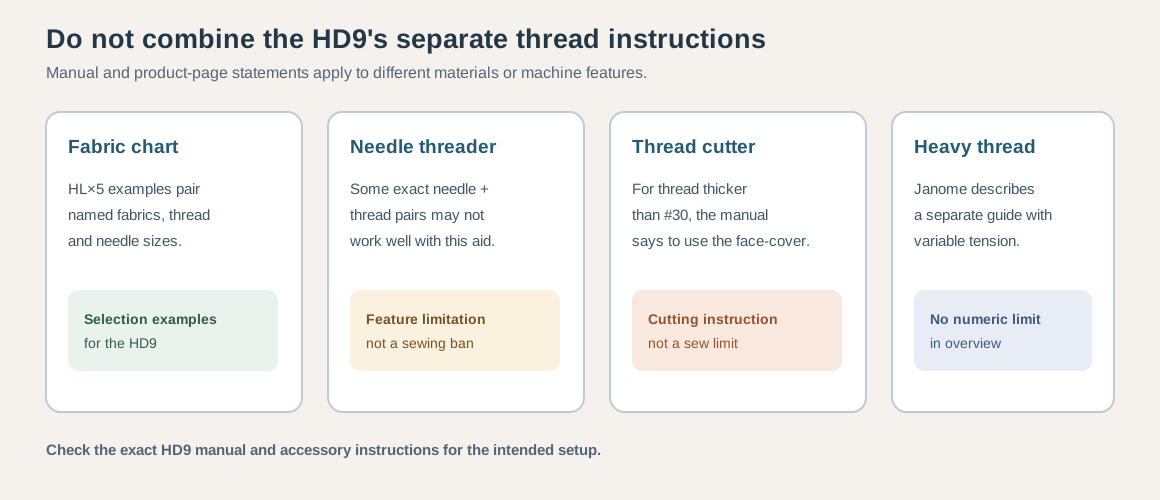
The manual says the built-in needle threader may not work well with these pairs: needle #9 with thread #20, #30, #50, or #60; #11 with #20 or #30; and #14 with #16, #20, or #30. This describes the threader, not a general sewing ban. The manual separately directs users to the face-cover cutter for thread thicker than #30. Janome’s current HD9 Professional page describes a Heavy Weight Thread Guide with variable tension adjustment and says heavier threads can be used with it. That is a separate feed option from the chart’s fabric examples and the cutter instruction. The overview does not give a numeric thread range or full setup steps; use the accessory instructions for your exact HD9 and do not infer a universal thread limit.
For stitch balance, the manual describes the needle and bobbin threads meeting between the fabric layers on a straight seam. Check the sample before changing tension; it says bobbin-screw adjustment is sensitive and should be slight. Follow the exact manual for needle replacement and threading, and test the actual layers. For another straight-stitch model, see the JUKI TL-2010Q guide.