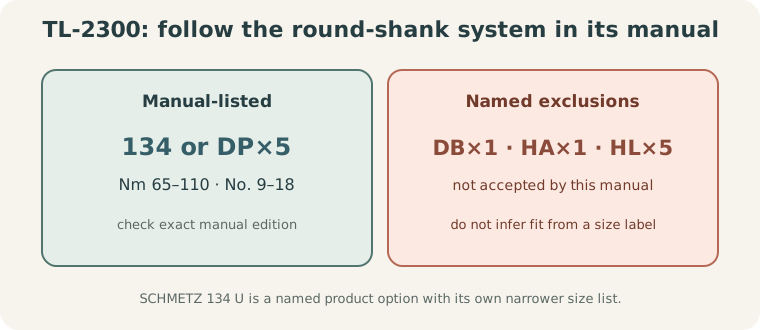
The JUKI TL-2300 manual specifies needle system 134 or DP×5, sizes Nm 65–110 or No. 9–18. It says other systems cannot be used and names DB×1, HA×1, and HL×5 as examples. A “TL” model name or a similar size number does not make its needle interchangeable with another JUKI model.
The manual’s material chart pairs thread-kind, Japanese-number, Tex, and needle columns within each row. Its selected examples use system 134 Nm 65–75 for light fabrics, Nm 75–90 for medium examples, and Nm 90–110 for heavy denim. Read the labels together across the exact construction row; these are not a thread-number conversion or a cross-material rule.
A named 134 U product is a narrower option#
SCHMETZ describes its 134 Universal Needle (134 U) as a round-shank 2 mm needle, available in NM 80, 90, and 100, and lists the JUKI TL-2300 as an example. Those sizes are only a subset of the TL-2300 manual’s 134/DP×5 range. SCHMETZ distinguishes the 134 U from standard 134(R) by shank length and eye design; do not assume every needle sold under a 134-family label is identical. Check the exact packet and machine manual.
The TL-2300 manual’s material chart has separate thread-kind, Japanese-number, Tex, and needle columns. Read a row within its printed construction and material context; it is not a universal conversion table. For needle replacement, switch the machine off, insert the listed needle fully with the long groove to the left and scarf to the right when viewed from the front, then secure it as the manual shows. Do not transfer this orientation to another machine.
For the TL-2010Q’s different HAx1/HLx5 references, use the model-specific guide.