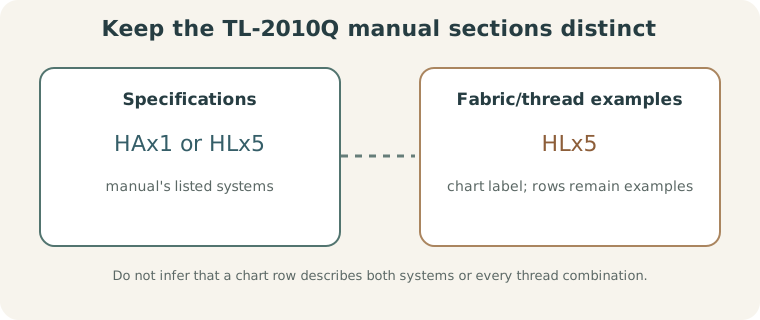
The JUKI TL-2010Q manual lists HAx1 or HLx5 needles in its specifications. Its fabric chart gives the following examples using HLx5; keep the manual’s thread-count labels as written.
| Material example | Thread example | HLx5 size |
|---|---|---|
| Nylon, cupro, georgette | Synthetic #80–90 | No. 9–11 |
| Broadcloth or gingham | Cotton #60–80 or synthetic #80–90 | No. 11–14 |
| Heavy denim | Cotton or synthetic #20–50 | No. 14–18 |
Topstitching has a separate needle chart#
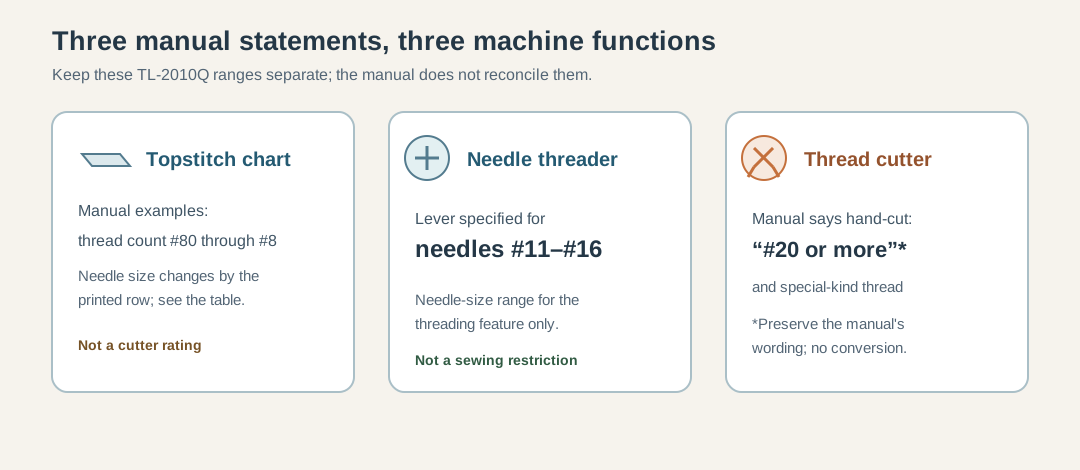
JUKI’s topstitching section says the machine can use standard runstitching thread through #8 topstitching thread, then gives these thread-count and needle-size examples:
| Manual thread count | Needle size |
|---|---|
| #80–50 | No. 11 |
| #60–50 | No. 14 (11) |
| #50–30 | No. 16 |
| #20–8 | No. 18 |
These are the manual’s own labels, not a conversion to another thread system. The page does not reconcile this topstitching range with its separate automatic-trimmer restriction below.
Threader and cutter are separate features#
The automatic needle threader lever is specified for needle sizes #11–#16. The automatic thread cutter has a separate restriction: the manual directs users to cut “thread as thick as count #20 or more,” or special-kind thread, by hand. The manual also has a topstitching chart with thread-count examples, but it does not reconcile that chart with the cutter wording. Do not treat a topstitching row as proof of automatic-cutter eligibility or convert these counts to another system.
For a model-specific bobbin check, the manual’s standard example uses #50 thread: hold the open end and shake the case as illustrated; it should descend slowly. Turn the machine off before removing the bobbin case. “Slowly” is qualitative, and the manual gives no force, distance, or screw-turn recipe. It says to balance needle-thread tension to the bobbin-thread result. This is not a universal drop test. When replacing a needle, turn off the machine, lower the presser foot, raise the needle bar fully, and insert the specified HAx1 or HLx5 needle fully with its flat face to the right. For the different TL-2300 needle system, see its separate guide.